Q & A
Update for all: you can find a copy of Greg's French Scene divisions at the top of the SCRIPT page

DECEMBER 1

I shared some of our information about Ken Ludwig and William Gillette in a production note published in the VPA newsletter to get our audiences ready to enjoy all of the hard work from the past few months!
NOVEMBER 30
TOM STOPPARD (1937-2025)
Tom Stoppard passed away yesterday. In a lovely remembrance, Carey Perloff-- retired Artistic Director of the American Conservatory Theatre in San Francisco and long-time collaborator-- shared the words of one of the characters in The Coast of Utopia, that feels like a fitting tribute to him.
I think Ken Ludwig would agree.
You can read her full tribute in American Theatre magazine.

“Art has the right to be useless, an end in itself, for its own sake…It only has to be true.” Invoking the image of wooden matryoshkas, he clarifies: “Not true to the facts, not true to appearances, but true to the innermost doll, where genius and nature are the same stuff. That’s what makes an artist moral.”
NOVEMBER 4
WWE's The Undertaker
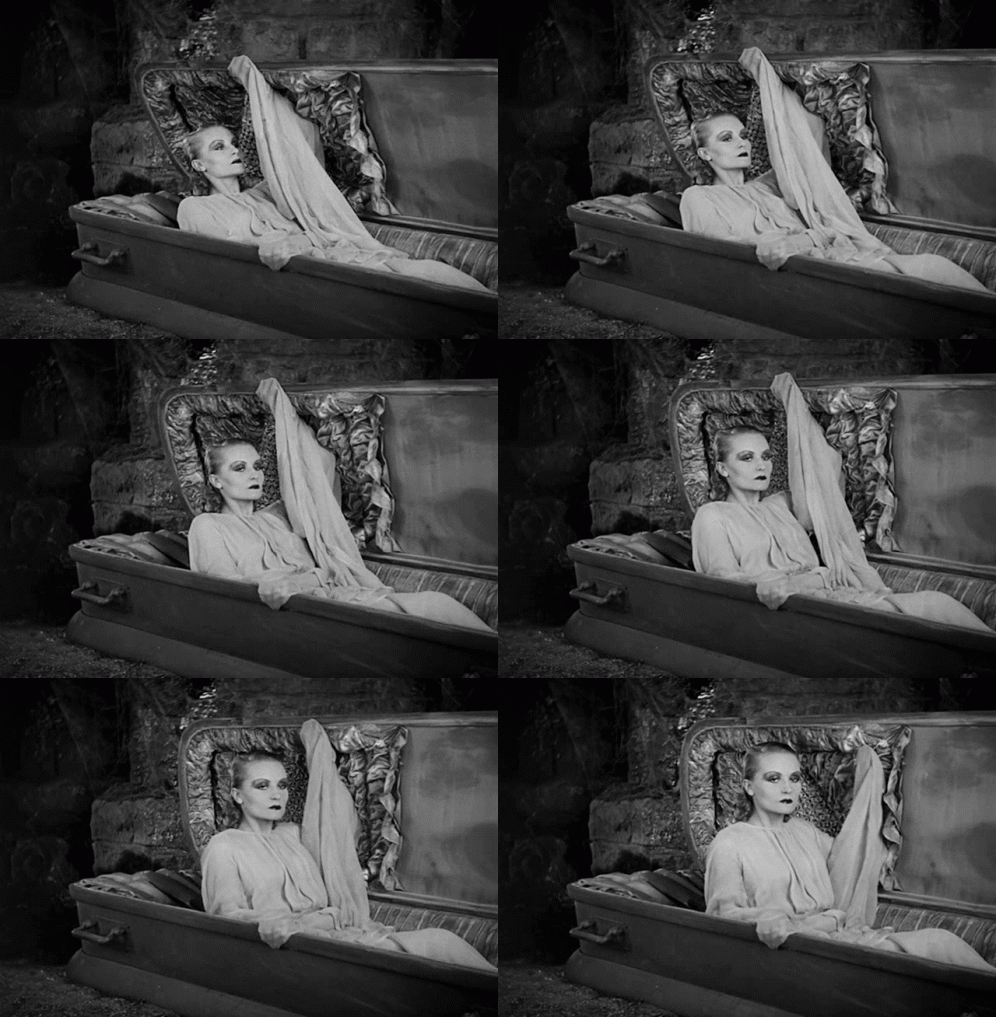
Professional wrestling is little more than theatre, and the "actor" was inspired by old horror films. So here's a little more of Bela Lugosi's DRAH-CU-LAH for you as well.
OCTOBER 30
Mary Jane (Mae) West was born in Brooklyn, NY in 1893. Her career began at age 14 on the vaudeville stage, performing in a pink and green satin dress, a large white hat and pink satin ribbons made by her mother. But she impersonated adult Vaudeville and burlesque performers, and danced and sang popular songs inflecting sexual overtones. West got her big break in 1918 in the Shubert Brothers revue Sometime, playing opposite Ed Wynn. Her character, Mayme, danced the shimmy, a brazen dance move that involved shaking the shoulders back and forth and pushing the chest out.
As more parts came her way, West began to shape her characters, often rewriting dialogue or character descriptions to better suit her persona. She eventually began writing her own plays, initially using the pen name Jane Mast. In 1926, West got her first starring role in a Broadway play entitled Sex, which she wrote, produced, and directed. Though the play was a hit at the box office, the "more respectable" Broadway critics panned it for its explicit sexual content. The production also did not go over well with city officials, who raided the show and arrested West along with much of the cast. She was prosecuted on morals charges and on April 19, 1927, sentenced to 10 days in jail on Welfare Island (now known as Roosevelt Island) in New York.
In the early 1930s Hollywood noticed West's talent and she became a contract player for Paramount Pictures. Her films included Night after Night, and the 1933 film She Done Him Wrong. West recreated the "Diamond Lil" characters from one of her stage plays. Renamed "Lady Lou," it included the famous line "Why don't you come up sometime and see me?" (A line almost always misquoted.) The film was nominated for an Academy Award for Best Picture, and also starred new comer Cary Grant in one of his first major roles. The film did tremendously well at the box office, and is attributed to saving Paramount Pictures from bankruptcy.
As with her vaudeville and stage roles, West was most known for her wry delivery of racy lines, filled with double entendres.
"JUST ONE MORE THING..."
This was the catch phrase of the 1970s' favorite TV detective, Lieutenant Columbo. Always seen in his signature tan trench coat, his mild-mannered ways never kept him from solving even the most complicated of crimes. Columbo was played by Peter Falk, who also played the grandfather in The Princess Bride. The show originally aired on NBC from 1971 to 1978 as one of the rotating programs of The NBC Mystery Movie. Columbo then aired on ABC as a rotating program on The ABC Mystery Movie from 1989 to 1990, and on a less frequent basis from 1990 to 2003. A few highlights are below.
OCTOBER 22
"A fly in the ointment"
Your faithful dramaturg spent quite a lot of time with Gen Z dictionaries and translators looking for something that "the yoots" would recognize, but alas there does not appear to be an equivalent. I did find something from the late 2000s when Hawaiian pizza made a new surge--and found many detractors. "Well that's a pineapple on my pizza" had a short life as an equivalent phrase.
The phrase itself is very old--actually from the Bible- and means something not fully tragic but moderately annoying nonetheless, that required action to be fixed.
Frasier Parties
The sitcom Frasier staring Kelsey Grammar ran from 1993 to 2004. It is a spinoff of the series Cheers, and was premised on bar regular Doctor Frasier Crane returning home to Seattle. The show also had a brief reboot on Paramount from 2023-2024. Below are a few clips of parties at the Crane home. 2 are from the early years and 1 is from the remount.
OCTOBER 21: Dudley Do-Right
During table work, Greg and Laurie mentioned Dudley Do-Right as an example of stereotypical, simplistic farce.
Dudley was a well-meaning Canadian Mountie who first appeared in segments aired during The Rocky and Bullwinkle Show. He would go on to have his own animated series, and eventually a feature film. Dudley often faced off with a mustache-twirling villain named Snidley Whiplash.
OCTOBER 21: Laurie's presentation in rehearsal
OCTOBER 20: Who the heck is Tom Stoppard?
Sir Tom Stoppard is a Czech-born playwright. He began his career in England in 1954 as a journalist, soon moving to London in 1960 to start his work as a playwright. His first play A Walk on the Water (1960), which was televised in 1963, soon reached London with a stage version titled Enter a Free Man (1968). His next work, Rosencrantz and Guildenstern Are Dead (1965), showed at the 1966 Edinburgh Festival to rave reviews. It became internationally known in 1967 after it was entered into Britain's National Theatre. Additional work includes stage plays Every Good Boy Deserves Favour (1978), The Real Thing (1982), Rock n' Roll (2006), The Coast of Utopia trilogy (2002), and Leopoldstadt (2020) Over the course of his career he has written for radio, television, film and stage. In 1988 he co-wrote the Academy Award winning screenplay for the film Shakespeare In Love.
His work is marked by "verbal brilliance, ingenious action, and structural dexterity."

"The Questions Game" from Rosencrantz and Guildenstern are Dead