
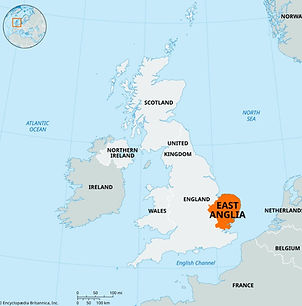
East Anglia is a term that’s still in use, to refer to the eastern counties of Norfolk, Suffolk, Cambridgeshire and Essex. It is a cultural and historical region within the East of England, one of the nine official governmental regions in Britain.
The Kingdom of the East Angles was formed in 520 with the merging of the North and South folk, who were Angles settled in the lands previously settled by the tribes of the Iceni. From there, the power of the Kingdom of Angles rose and fell due to ongoing wars with neighboring kingdoms. In 870, the Danes took the kingdom, which they renamed East Anglia. The Saxons then retook East Anglia briefly in 920; however, they were unable to hold onto it and lost it to Canute the Great in 1015. After the Norman Conquest, the Duchies of Norfolk and Suffolk were formed, and more formal borders were drawn up. The agricultural nature of the lands made them important throughout the Middle Ages. However, much of the power and importance of East Anglia declined after the Industrial Revolution as manufacturing moved to the Midlands and the North.
During the Second World War, the Royal Air Force and the United States Army Air Force built many airbases in East Anglia. These were used by large bomber planes flying missions against German-occupied Europe. East Anglia was perfect for airfields because it has lots of flat, open land and is close to mainland Europe. Many of these old airfields can still be seen today, and some are still used, like Norwich International Airport.
East Anglia contains several important landmarks: Cambridge University, Ely and its famous cathedral, and Sandringham House in Norfolk--the country estate of the Royal Family. It is a popular tourist destination.

ECONOMY AND SOCIETY
East Anglia's economy evolved from a wealthy medieval epicenter of the wool and textile trades into a highly productive agricultural powerhouse. Today, it has diversified into a modern hub for biotechnology, green energy, and logistics, anchored by world-class university research in Cambridge.
Before the Industrial Revolution, East Anglia was historically one of the most prosperous and densely populated regions in England. Its coastal proximity to Flanders made it a natural gateway for international trade. Towns like Worsted (which lent its name to worsted yarn), Aylsham, and Norwich became massive textile hubs. By the 15th and 16th centuries, the wool and cloth trade drove immense local wealth, as seen in the construction of the region's famous "wool churches".
Following the decline of its textile industry in the 17th century—as manufacturing shifted to the coal-rich Midlands and North—East Anglia pivoted to agriculture. Norfolk was particularly well suited to the export of grain to the continent. By 1794, more grain was leaving the ports of Norfolk for Holland than from the whole of the rest of England. But whereas in the 16th and 17th centuries a majority of the populace owned land, many with only small holdings, a fundamental change in the agricultural situation gradually occurred during the 17th and 18th centuries. This was the change from openfield strip farming to enclosed fields (the controversial process called 'enclosure'), which had profound social as well as organizational effects. Previously farmers often shared ploughs, horses and manual tasks; now farms were strictly individual units with very small owners often left with unworkably smallholdings. By 1750, however, there were very few strip fields remaining, and as a result of private exchanges, farms were being consolidated. The poor lost their rights to gather timber for fuel and to pasture a cow or pig on land traditionally available to them. So the social effects were quite serious.
In a fifty year period in the late 18th century, wages rose by only 25 per cent but the cost of living increased by 60 per cent. Labourers were in a weak bargaining position due to the over-population from which Norfolk was suffering.
SOCIAL CLASSES IN THE GEORGIAN ERA
Wealthy Landowners
This was the most powerful group, which made up the smallest amount of the population. It included the most important of the aristocracy and squires.
Gentry
This included those who received a high standard of upbringing but were not as important as the upper echelon of wealth. This included: gentlemen, merchants, wealthy tradesmen, and well-off manufacturers.
Yeoman
Yeoman were those who owned and worked their own land. They are also better known as “freeholders.”
Middle Class
A newer rung on the social ladder came to be known as the blooming middle class comprised about 15% of the population. The upper middle class included certain professionals and merchants. The lower middle class included artisans, shopkeepers, and tradesmen.
Laboring Poor
This comprised almost 25% percent of the population and it included all who worked in rural areas, did menial jobs, and the “urban laboring poor,” who worked in the country side.
WOMEN AT THIS TIME
"The 18th century is an age defined by gender inequality and discrimination. The idea of the superiority of men and their ownership of women made women oppressed victims of the patriarchal society. Receiving little respect, surrounded by an ill-conditioned society, women were the suffering sex relying on the mercy of men. As child-bearers and homemakers, women spent their lives as 'dependents'. The home was the woman's sphere. Female education was limited to practical training for their domestic roles such as home management, laundry, cookery or piano classes, and needlework. These customs and beliefs of society, reflected in the English language and also in many works of literature, defined 'the woman' as the second sex; however, women began to defend their rights towards the end of the century.
According to English common law at the time, women had very little economic freedom. All properties that women possessed before marriage automatically became their husbands' after the union. For that reason, women coming from wealthy families were regarded as 'preys.' A married woman basically had no legal identity before common law."
WORKING
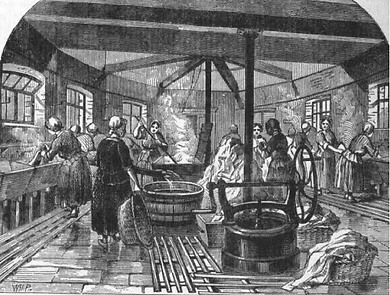
"In the Georgian era many professions were thought of as exclusively ‘women’s work’, namely domestic work, and were deemed unsuitable for men. Many other roles and trades were increasingly accepting women into their working ranks. Although books and other media of the period, and contemporary depictions, often focused on upper class Georgian women as ladies of leisure, women of the lower and emerging middle classes often needed to support themselves and their families through their working wages.
A girl may have sought work in her adolescence to supplement her family’s income in lieu of education, as did wives whose husbands did not earn enough to get by. Unwed women and widows worked to support themselves, with many occupations for women requiring her to be unmarried. The most common occupations for women were housework and childcare. By the end of the 18th century, business-minded women might have opened draper shops, selling fabric by the yard, trimmings and other haberdashery supplies or served as the landlady in a rooming house.'
Read more from the Hampshire Cultural Trust.
The Welkin correctly indicates that women were midwives before and during this time. It was not, however a recognized position for which women were paid. Training was passed down from one midwife to another. In the 1600s, midwives were "certified" by a bishop to ensure they would not use any witchcraft during the delivery.

The Church also issued licenses to physicians, surgeons and apothecaries. When the Church ceased to discharge this function and medical faculties gave Licenses, the midwife unfortunately was ignored.
ANNUS MIRABILIS
It was the year in which Britain pivoted into the modern world, anchoring itself as the master of that new world along the way. Partly this was because, by creating institutions such as the British Museum and Kew Gardens, this country firmly planted the ambition for a public realm in which intellectual and cultural life was open and accessible to all. This principle would later give birth to the BBC, the Open University and even the World Wide Web, pioneered by Tim Berners-Lee in this tradition of free access to information and communication.
At the same time, British military triumphs in 1759 proved the catalyst not only for the French Revolution and the British Empire, but also for fostering the conditions that would later goad Britain’s American colonies – freed from the threat of attack from a France burdened with war debts – to seize their independence.