MIDWIVES AND CHILDBIRTH
In the early 18th century and before, birthing was a woman's business. Midwives had all to do with birthing no matter the status of the woman giving birth. Physicians played no role in childbirth unless a midwife needed the physician's surgical tools or surgical knowledge in the event of death. Midwives trained from the passing of knowledge from a senior midwife, typically a community herbalist or healer, and were "licensed" through the church. These were, regardless of their own social and financial status, well-respected members of the community.
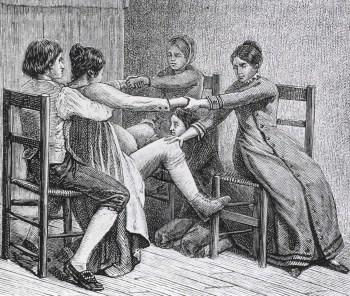
Midwives, used herbal mixtures and caudle (a hot, thickened drink often incorporating wine or ale) while promoting walking to induce labor, the birth itself being helped by gravity through a kneeling position or a birthing chair. It was not uncommon for the midwife to recruit the help of the husband to hold the wife steady. The birth was in the comfort of the home with loved ones nearby, and the midwife always went to the mother rather than the other way around.

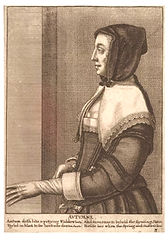
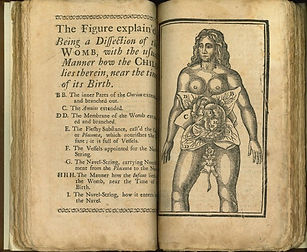
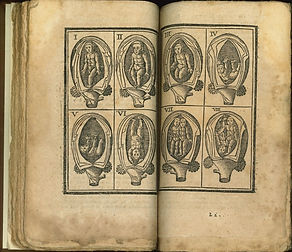
In 1671, Jane Sharp wrote a book that sought to educate midwives in anatomy, to inform expectant mothers about pregnancy and childbirth, and to defend the practice of midwifery as a female-only occupation. She published an update in 1725, shortly after a self-identified retirement from the profession.
The language of the text is reflective of the time Jane Sharp was writing in. Reading the book requires a lot of imagination, and an ability to decipher the book’s metaphoric language. Jane Sharp makes references to medical theories (humoral theory, particularly) and astrology to explain the natural occurrences of childbirth-- the foundation to medicine in Sharp’s time. Sharp also references astrological events, such as the full moon and the celestial zodiac, affecting the conception and birth of babies. The forces of nature were interpreted to have a deep impression on humankind, influencing all aspects of life.
Samples of the book can be seen below. Clicking either image will allow you to view the entire book online.
ASTROLOGY AND PREGNANCY
Jane Sharp references astrological indicators of pregnancy and childbirth because they were a notable part of "medical" practice at the time. In her article "Clockwork Sky," author Romany Reagan noted that
If astronomy is the study of the movements of the heavenly bodies, then astrology is the study of the effects of these movements. Essentially, one discipline is raw data, the other the interpretation of that data.
The most common way to keep track of astrological information was the almanack. They were small booklets that included predictions for the coming year, medical advice, meteorological information, tides tables, and other encyclopedic information. Often, they included anatomical diagrams of the zodiacal man. The golden era of almanacs in England spanned 1550 to 1700, with a special boost in popularity in the second half of the 1600s.
The State Library in Victoria produced an episode of their Rare Book Club which offers a peek at almanacks
The most famous women's almanack of the period was written by Sarah Jinner. Jane Sharp would certainly have been familiar with it. Author Olivia Campbell states that "We don’t know much about the life of English astrologer Sarah Jinner, when she was born, when she died. What we do know is that she lived in London and published three almanacs between 1658 and 1664. These texts were positively brimming with health and wellness advice that reflected a desire to preserve and share knowledge that could improve women’s health—and their sex lives. Sarah’s almanacs are unique in that they are authored by a woman, and she is often thought of as one of the first women in England to make a living writing. In her almanacs, Sarah offers up recipes for aphrodisiacs, and remedies for infertility, gynecological illnesses, and incontinence. She outlines the best times to engage in sexual activity, and when to refrain from it. Knowledge of ovulation and its role in conception was still a long way off, so Sarah’s advice for good or bad times to conceive were based on astrology....In addition to medical advice and guidance on sexual health, Sarah’s almanacs make specific weather and agricultural predictions, tracks the lunar cycles, and calculates the position of the planets. "
Astrological confirmation of pregnancy was considered even more reliable than the alternative in the 16th and early 17th centuries-- an evaluation of the woman's urine. Some of the "tips" in the Jinner almanack are below. The full 1659 edition is also available.
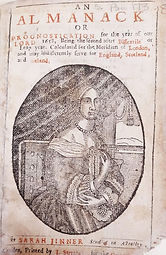
Sex anytime in July was ill-advised
September 12, 1658: “Venus being in Scorpio, I fear that the naughty wantons of our sex … will be peppered with the pox.”
The total solar eclipse of November 14, 1659 would bring with it amorousness: “many Ladies that had been besieged by suitors [will] … surrender.
Having Venus in the twelfth house in opposition to Jupiter in the first house, and the Moon in the seventh in Scorpio, doth foretell many diseases in women.
Mercury in the ninth house puts you a jogging to see your friends, and delight in discourse, as gossipings
Some almanacks included a small interactive component on the page. It was a small wheel known as a volvelle that could be adjusted to each month for gestational information for the expectant mother.
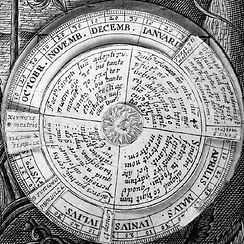
A pregnancy volvelle from an almanack
(click to enlarge)
A more general astrological volvelle, demonstrating movement
"Fruitful Bodies and Astrological Medicine" from the book Reproduction: Antiquity to the Present Day contains some additional information about beliefs of the time.
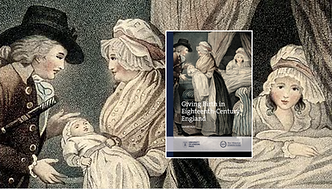
In her book Giving Birth in 18th Century England, Sarah Fox notes that "[b]irth reached out far beyond the confines of the birthing chamber. Birthing and its rituals and practices created communities of neighbours, focused on the new infant and its household. Growing bellies allowed the community to anticipate a birth, while the broadly observed rituals and practices of birthing provided a well-worn and familiar rhythm of visiting and socialising. When a woman reached her ‘time’, neighbours and family members would gather, to act as midwife’s assistants, to hear the first cry of the infant, to share drinks and cake, and to hold the baby and share local information. These gatherings could be quite disruptive, removing women from their central role in their own households to create a new, transient household centred around the birthing woman."
Fox wrote about her book and her research in several articles that might be of interest, one of which was published by the Royal Historical Society.The entire text has been published as open access by the University of London Press.

In Scene 3 "Execution Day," Elizabeth and Coombes talk about the trial and the fact that Thomas McKay has already been executed. Elizabeth states that she has spent the past two days helping to deliver twins, only one of whom survived because the house was drafty and the mother did not drink her caudle.
She also describes having lost 12 babies in the past year, which would likely be on the high side of the average of the time.
MEN IN THE PICTURE: PHYSICIANS, SURGEONS, AND MAN-MIDWIVES
By the mid 18th century, physicians saw the power in defining medicine as science. Since women were not welcome in the science community, physicians saw it as a perfect opportunity to gain both power and profits. Instead of working with midwives, they began a campaign against them, spreading untruths about their practices, calling them witches, and establishing themselves as the choice for high society. Though they knew little to nothing about the birthing process, it didn't take long for high society to turn this into a status war--commoners could have the midwives, and those of the upper crust could have physicians.
About 1730, the surgeon-apothecary experienced a substantial rise in status and prosperity as he expanded his activities and looked for new openings in the thriving business of medical practice." Man-midwifery was an additional source of income and an excellent way to acquire and to keep a practice of regular patients. The expansion in the activity of the rank-and-file practitioners was accompanied by a demand for better medical education. Hospital training commenced around the middle of the eighteenth century and it was often combined with attendance at private courses in midwifery.
The physicians' methods were a tad frightening, including such practices as having women "lying in," which meant being prone on a bed for a month before birth (and after) in a darkened (near to pitch black) and heavily heated (sauna) room while being bled regularly. The final result was the physician extracting the baby forcibly with the newly invented forceps, namely because the women were too weak at that point to help in the process. Soon, physicians created "lying in" hospitals to require mothers to go to them rather than them to the mothers, and to remove the family unit from the birthing process.

The City of London Lying-In Hospital
ELIZABETH. Why should the word of a doctor mean more to you than my own? When l brought your children into the world, you trusted me then did you not? When the curse was upon you, when your babies would not take the breast, or your milk would not come, when it was the middle of the night and you did not need anything but to lie on a warm lap and cry. When your nipples cracked and your pitchers split and your husbands could not get it up. you trusted me then!
-page 82
MATERNAL MORTAILY
The World Health Organization defines maternal mortality as “the death of a woman while pregnant or within 42 days of termination of pregnancy.” Such deaths can occur for a variety of reasons, including bleeding and infection after childbirth, high blood pressure during pregnancy, complications during delivery and unsafe abortion.
Early statistics are difficult to come by, but British parish records indicate a maternal mortality rate of 1,000 per 100,000 live births in the first half of the 18th century. Since women were pregnant more often than is the case today, the actual risk of dying due to complications from pregnancy would have been much higher.
Alice Reid of the Cambridge Group for the History of Population and Social Structure at Cambridge University has conducted significant research on the dangers of childbirth in the past. Below are a few useful excerpts from an article published in September 2024.
-Changes in obstetric care were not responsible on their own for changing trends in maternal mortality in this period. Maternal mortality trends run parallel to trends in general mortality until the mid-19th century, and this indicates that changes over this period were driven by changes in the underlying health of women. It was likely that changes in women’s health were affected more by changes in exposure to epidemic disease (which was likely to have affected everyone) than by changes in the quality or quantity of dietary intake (which was likely to have affected social groups differently).
-Alongside maternal mortality, women of childbearing age also faced the dangers of accidents and diseases, which were also much higher in the past than they are today. Over the pre-industrial period as a whole, the risk of a woman dying in childbirth, or the 6-8 weeks following it, was similar to the chance of dying from a non-maternal cause over the course of a year. Because women did not face the risk of childbirth every year, only around one in ten deaths to married women between the ages of 15 and 49 would have been due to childbirth. Childbirth was therefore far from the dominant cause of death, and women had far more reason to fear dying from a different cause.
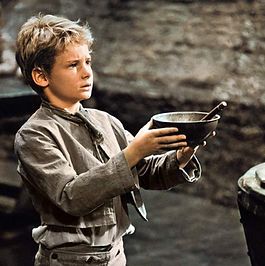
-Interestingly, our perception of maternal mortality in or due to childbirth is highly skewed by literature of the era. This plot device of placing surviving child into a challenging environment has frequently been a good opportunity for an interesting narrative. Oliver Twist is one example. And Jane Austen parodied the trend in her satirical novel Northanger.