October 2: Signs of Pregnancy
In Early Modern England, a woman's understanding of pregnancy was still heavily influenced by the texts of prior periods, especially the Middle Ages, when writings came from three main "experts" on the subject. The most common physical signs from each are below. In addition to cravings and aches, each believed in the validity of testing urine, though the results of a positive pregnancy were slightly different.
Thomas Chamberlayne- The Compleat Midwifes Practice (1656)
Chamberlayne described how a woman who had recently conceived might get headaches, vertigo, lose her sight and her eyes would appear sunken. The veins in her tongue would turn green, her neck would get hot and her back cold, her breasts would become cold, her appetite would wane, she would vomit and her belly would swell. For Chamberlayne, there would be "certain live things, to creep up and down" in a pregnant woman's urine
Jane Sharp, The Midwives Book (1671, 4th edition in 1725)
Sharp had a list of 14 signs a woman was pregnant. She supposed that the belly would initially grow flat, she would get a sharp pain above the navel, lose her appetite, her periods would stop, she would have difficulty defecating, "sometimes she will be merry, or sad suddenly upon no manifest cause" and she might have "a preternatural desire to something not fit to eat nor drink, as some women with child have longed to bite off a piece of their Husbands Buttocks". Sharp thought that a pregnant woman’s urine would produce worms if left for three days
Robert Barret, A Companion for Midwives, Child-bearing Women, and Nurses Directing them how to Perform their Respective Offices: Together with an Essay, Endeavouring to Shew the Influence of Moral Abuses upon the Health of Children (1699)
Robert Barret thought that ten days after conception a woman would have her ‘Terms’ or period, but this could be white or red, but these would soon cease. He also told readers that her breasts would become "big and hard with pain, and the Nipples grown red". Her urine, according to Barret, would be white.
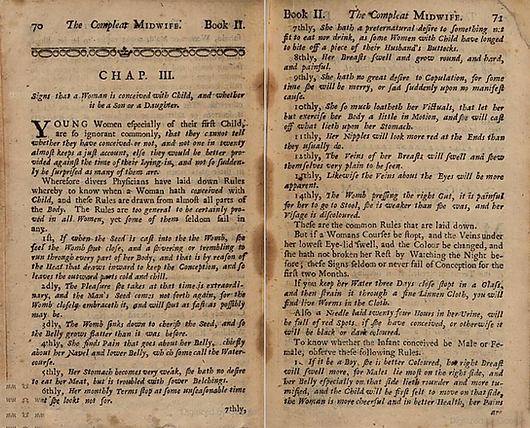
click the image above to see the relevant pages from Jane Sharp's book,
or take a look at this section of the book itself.

October 1: Answering Questions About Prisoners
How were prisoners held between trial and execution?
For a condemned prisoner in the 1750s, the gap between sentencing and execution was pretty short. Murder Act 1751, an act of the Parliament of Great Britain, stipulated that a person found guilty of murder should be executed two days after being sentenced unless that day was a Sunday, in which case the execution would take place on the following Monday.
Would Sally have been in a jail cell between her trial and the time she appears before the matrons?
Likely not. The legal mechanism of pleading the belly dictates that “the plea did not constitute a defense and could only be made after a verdict of guilty was delivered.” According to The Office of the Clerk of Assize, a legal manual written in 1694, the entire examination took place immediately within the courthouse as a continuous and uninterrupted sequence of events.
The manual dictates that once a woman was found guilty and alleged she was pregnant, the matrons were sworn in on the spot to “search and try the Prisoner at the Bar”. The accused is explicitly noted as a prisoner “at the bar”, so this implies she remained standing in the open courtroom rather than being sent to a holding cell. Following the oath, “one of the Bailiffs shall convey the Jury and the Prisoner to a chamber”, a room within the courthouse (not a holding cell). Finally, the text proves that the formal death sentence was withheld until after the examination, noting that “Judgement shall not be delayed, but shall be presently given to her” only after the matrons returned to the court to deliver their verdict. This proves that she would not have gone to a holding cell between her trial and the time she appears before the matrons, because the entire legal procedure happened continuously, leaving no physical gap or administrative delay for her to be transferred back to a cell.

For more information, you may be interested in exploring the manual for the Clerk of Assize further, or The Executioner's Bible
September 30: Witches in the Water
Although scholars disagree about whether or not the practice came to the United States, drowning witches was definitely a practice in Medieval and Early Modern England. According to the Foxearth and District Local Historical Society in England,
"[T]he official use of 'swimming' in English law dates back to King Athelstan (928-930), where trial by water, termed 'indicium aquae', was a general test for all crimes. It ceased to be an official Law in 1219 under Henry III's reforms. For the next six hundred years it was popularly, but unofficially, supposed to be infallible in discovering the guilt of witches and those suspected of subscribing to the black arts .It was believed that water rejected servants of the devil and that if a suspected person floated and refused to sink when placed in water it was proof of guilt. The ordeal of 'swimming' was endorsed by James I of England, who stated in Daemonologie (1597) 'that God hath appointed ... that the water shall refuse to receive them in her bosome, that have shaken off them the sacred Water of Baptisme, and willfully refused the benefite thereof.'"
The last recorded official 'swimming' of a wizard in East Anglia was inflicted on a Mr Stebbings at Wickham Skeith who was 'swum for a wizard' in July 1825. This was related in The Times for 19th July 1825. This description was based on a report in the Suffolk Chronicle of a case of supposed witchcraft in that county.
King James I was predisposed both to believe in witches and to support their execution after a harrowing event when he and his new bride nearly lost their lives to a series of bad storms in the North Sea while traveling from Denmark to England. The "investigation" into the matter led several witches to confess to putting a curse on them.

"The Swimming of Mary Sutton" (1615)
September 25: Lucy Kirkwood's Inspiration
While preparing to talk about the structure of The Welkin in Dramatic Lit, I listened again to the podcast interviews I posted earlier. Kirkwood's description of how the film The Parallax View served as an inspiration for the beginning of the show struck me, so I went looking for video footage. I combined the clip with the video of that opening for class, and I'm sharing it here for all of you!
September 20: Rich Man, Poor Man, Beggar Man, Bailiff?
The sheriff and the criminal bailiff in the 18th century did not receive a salary. Instead, they were paid fees for specific duties and occasionally a percentage of the value of stolen goods recovered. The system was ripe for bribery, and both county officials often supplemented their income this way. In a smaller county, all work was done by the sheriff. In a broader region like East Anglia, criminal bailiffs worked almost as an assistant sheriff.
(Note: "criminal bailiff" refers to one who works in the criminal justice system, as opposed to a "bailiff of husbandry" who served as an overseer on a farm or large plot of land.)
The best record of such fees is found in the Sheriff's Bill of Craving, which was submitted annually to the Exchecker. According to Anna Cusack in "How to History," [s]heriffs often ran county gaols and as such kept records of individuals confined there. Maintaining prisoners before trials, execution expenses, and escorting prisoners to transportation and into prison hulks, all appear in the cravings. They claim amounts for carrying out whippings, and as the historian Simon Devereaux noted, ‘systematic review of these records suggests much about the changing character and proportion of public, physical punishments in Hanoverian England, as the sheriffs were obliged to distinguish between the amount claimed for a ‘common’ whipping and that claimed for a whipping ‘at the cart’s tail’ along a specified route’. Until 1779 £1 could be claimed for ‘common’ and £2 for ‘cart’s tail’ whippings, they were thereafter tripled to £3 and £6.The costs for gibbeting individuals after their executions are also in the cravings. The average gibbet cost £16 but some cost more than £50. It was an expensive practice, and the cravings show the cost incurred from hiring the smiths to measure an individual criminal while alive, so they fit their gibbets perfectly, to the erection and transportation of a body to a gibbet site and the security needed while the act was performed.
A little math: £1 in 1758 is worth £232.99 today. That is just over $312 US dollars.
For additional context, you can explore 18th century wages and expenses
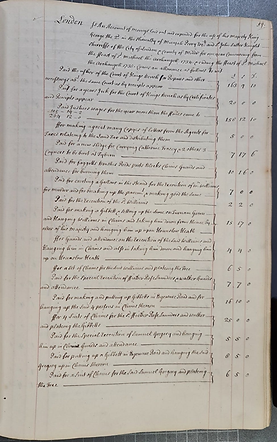
Sheriffs' cravings, 1735-1739. From the UK National Archives
The Sheriff's Act of 1887 finally put a check on both the behavior and the abuses of sheriffs and bailiffs. The act established salaries for both positions and outlined repercussions and penalties for illegal and immoral behavior.
September 11: Brimstone
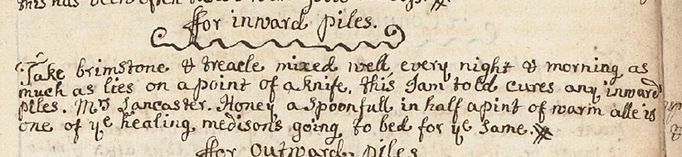
Sulphur has long had a beneficial medicinal role. It was used both externally, in the form of ointments for the skin, and internally as the medicine called brimstone. It was combined with both molasses and amber for different uses.
According to the Archivist at Eton College in England:
Brimstone, a form of sulphur, and treacle or molasses were commonly used as a cure-all at a time when medicine was not readily available to the masses. Charles Dickens mentions its use in Nicholas Nickleby, showing that even 150 years after the first recipe was written its popularity had not decreased. It is the threat of this treatment that makes Michael and Jane Banks write their definition of a good nanny in Mary Poppins, when their father’s choice and former nanny says “Brimstone and Treacle and codliver oil, liberal doses of each. These are the treats from which children recoil, the lessons I’m going to teach”.
The benefits of sulphur as an anti-oxidant and detox agent have been known for thousands of years. Part of the popularity of spas was the sulphurous content of the water, and modern day diets such as the cabbage soup diet are based on these properties. It has been used to cure skin complaints, as a laxative, and to relieve aching joints.

page 22- Katy is probably described as "painted yellow" because she has a topical application of brimstone and amber to treat a skin or muscular condition