COMETS 101
Halley’s Comet was both the first comet whose return was predicted, and to be photographed up close by spacecraft.
In the year 1705, English astronomer Edmond Halley published a catalog of the orbits of 24 comets, 3 of which had very similar orbits. He suggested that these were all actually the same comet - observed in 1531, 1607, and 1682 – and he predicted that the comet would return in 1758.
The comet indeed did make an appearance late 1758, and hit perihelion (when a comet is at its closest distance to the sun, and consequently usually when it is at its brightest) in March of 1759.
The comet was named after Edmond Halley, who passed away in 1742, 16 years before the comet came back This matters because it proved comets have an orbit and are predictable, not one-off mysterious events. This particular comet matters because it was the first successful prediction of a comet's return.
Encyclopedia Brittanica

In his book "A Comet Called Halley," British author Ian Ridpath explains further.
Halley’s Comet takes an average of 76 years to orbit the Sun, covering 11,500 million kilometers in the process, but in practice the intervals between successive returns can be a few years longer or shorter than this due to the gravitational pulls of the planets which sometimes speed it up and sometimes slow it down.
Measured from one perihelion to the next, Halley’s quickest return was after 74.4 years, from 1835 November to 1910 April, while the longest interval was 79.25 years, from 451 June to 530 September. At its most distant (aphelion) the Comet retreats to 5,300 million kilometers from the Sun, beyond the orbit of Neptune. At its closest (perihelion) it passes 88 million kilometers from the Sun, between the orbits of Venus and Mercury. In accordance with the laws of planetary motion, when farthest from the Sun the Comet is moving slowest, at 3,280 kilometers per hour, while at its closest it is moving most quickly, at 196,000 kilometers per hour (on each orbit the exact figures differ slightly).
Halley’s Comet last reached aphelion on 2023 December 9 and is now on its way back towards the Sun, with a predicted perihelion date of 2061 July 28.
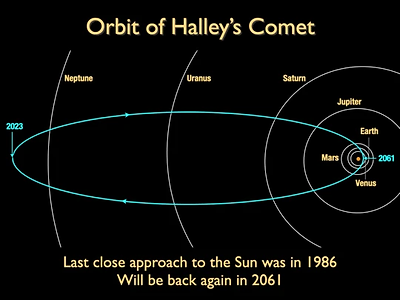
For real-time tracking of the comet, you can use this online tool created by Nasa and Jet Propulsion Labs.
(If you reach a chart instead of a graphic, click show next to the heading Orbit Viewer at upper left.)
HOW PEOPLE UNDERSTOOD COMETS

"The lower class got a lot of their information by rumors. A simple study on the statistical probability of a collision between earth and an arbitrary comet was misconstrued by rumor as a prophecy of imminent destruction."
-Philip Stewart, "Science and Superstition: Comets and the French Public in the 18th Century," American Journal of Physics, 1986

The Linda Hall Science Library & Arboretum in Kansas City has devoted much time to studying astronomy in early modern times. You can explore their findings.
A few highlights:
Poor people at the time would have likely thought a comet could trigger an apocalyptic, biblical event. They would have thought they were the cause of various biblical plagues, like total darkness.
People also thought comets could be linked to earthquakes, and thought that the sight of a comet could indicate imminent earthquakes to come.
Johann Georg Palitzsch, a humble German farmer, and aspiring astronomer (he was raised to be a farmer but secretly studied astronomy, and even built his own telescope), was the first person credited with seeing the comet in 1758, on Christmas night.
Title page drawing featuring a comet and a Bible verse, 1619. Image source: Bainbridge, John. An Astronomicall Description of the Late Comet from the 18. of Nouemb. 1618. to sthe 16. of December. London: Printed by E. Griffin for J. Parker, 1619.
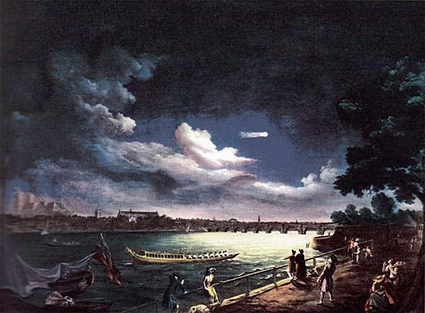
Painting of the Thames in London, showing Halley’s Comet in the sky, oil on canvas, by Samuel Scott, 1759

MARY: My granny saw an angel.
HANNAH: She never.
MARY: She did. Last time the comet came. It flapped its wings so hard the thatch come off the roof and that night, she gave birth to a very hairy boy with two thumbs on one hand.
THE ROYAL SOCIETY
Following a lecture by Christopher Wren in 1660, twelve men of science established a 'College for the Promoting of Physico-Mathematical, Experimental Learning' at Gresham College, London. The Royal Society would gather information by correspondence, but its Fellows would also observe the natural world, conduct experiments, discuss their outcomes, and eventually publish the results.
-
Despite the comet being seen by a farmer that nobody knew, most of the people who had access to the knowledge and math surrounding comets were wealthy gentleman scientists. Many of them were connected to the Royal Society, which laboring classes had essentially no path into.
-
This kind of scientific knowledge stayed concentrated among a very small elite. During the decades surrounding the comet’s return (1735-1780) the Royal Society was composed of roughly 20% aristocrats, 16% clerics and scholars, 16% physicians, 15% courtiers and civil servants, and 15% gentlemen, leaving essentially no room for ordinary common folk.

"Old Woman reading a Lectionary : the so-called portrait of Rembrandt’s mother," Neeltgen Willemsdr van Zuijdtbroeck’ (c.1631-32)
According to BookBrunch, British literacy rates for men and women in the mid-1750s were around 60% and 40%, respectively.